
Ask & Answer: India's Largest Education Community

All Questions
New Question
10 months agoContributor-Level 10
115.
Solution :
The given function is f, being a polynomial function, is continuous in [1, 4] and is differentiable in (1, 4) whose derivative is 2x − 4.
Mean Value Theorem states that there is a point c ∈ (1, 4) such that f' (c) = 1
Hence, Mean Value Theorem is verified for the given function.
New Question
10 months agoContributor-Level 6
A typical structure for a statement of purpose is as follows:
- Introduction
- Academic and Professional Experience
- Post programme Career Goals:
- Program-specific Information
- Conclusion


New Question
10 months agoNew Question
10 months agoContributor-Level 10
114. Solution :
It is given that f: [-5,5]? R is a differentiable function.
Since every differentiable function is a continuous function, we obtain
(a) f is continuous on [?5, 5].
(b) f is differentiable on (?5, 5).
Therefore, by the Mean Value Theorem, there exists c? (?5, 5) such that
It is also given that f' (x) does not vanish anywhere.
Hence, proved.
New Question
10 months agoContributor-Level 10
The given D.E. is
Hence, the D.E. is homogenous
Let, so that, is the D.E.
Thus,
Integrating both sides,

New Question
10 months agoContributor-Level 10
To get into Parle Tilak Vidyalaya Association's Sathaye College for the BA course, candidates must meet the eligibility criteria set by the institute. Students must pass Class 12 in any stream. Parle Tilak Vidyalaya Association's Sathaye College offers full-time BA courses of three years' duration. Students can get into this course based on merit.
New Question
10 months agoContributor-Level 10
The Given D.E. is
Hence, the given D.E. is homogenous.
Let, in the D.E
Integrating both sides we get,

Putting back we get,
is the required solution.
New Question
10 months agoContributor-Level 10
2. 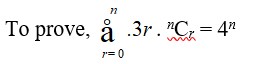
By binomial theorem,
(a + b)n = nC0 (a)n (b)0 + nC1 (a)n–1 (b)1 + …………. + nCr (a)n–r (b)r + …………… + nCn (a)n–n (b)n
Where, b0 = 1 = an–n
So, (a + b)n = nCr (a)n–r (b)r
Putting a = 1 and b = 3 such that a + b = 4, we can rewrite the above equation as
(1 + 3)n = nCr (1)n–r.3r
=>4n = .nCr
Hence proved.
New Question
10 months agoContributor-Level 8
Pursuing MBA in Japan is extremely affordable with annual tuition fee as low as INR 6 K. On average, annual cost ranges between INR 3 L - INR 10 L. Check out the table below for the annual tuition cost required in the top B-schools in Japan:
University | Annual Tuition Cost |
|---|---|
INR 6 K | |
INR 3 L | |
INR 3 L | |
INR 3 L | |
| Niigata University | INR 3 L |
INR 9 L |
New Question
10 months agoContributor-Level 10
The Given D.E. is
Hence, the given D.E. is homogenous.
Let, in the D.E
Then,
Integrating both sides,
Putting back
New Question
10 months agoContributor-Level 10
113. Solution:
By Rolle’s Theorem, for a function if
f is continuous on
f is differentiable on
f(a)= f(b)
then, there exists some such that
therefore, Rolle’s Theorem is not applicable to those functions that do not satisfy any of the three conditions of the hypothesis.
for
It is evident that the given function f(x) is not continuous at every integral point.
In particular, f(x) is not continuous at x=5 and x=9
f(x) is not continuous in
Also,
The differentiability of f in is checked as follows.
Let n be an integer such that .
The left hand lim
New Question
10 months agoContributor-Level 10
The fee range for the BA programme at Parle Tilak Vidyalaya Association's Sathaye College ranges between INR 2,400 to 30,000. This information is sourced from official website/ sanctioning body and is subject to change. The fee cover various academic expenses like tuition fees, examination fees, library fees, and other relevant charges. It is important to note that the fee structure is subject to change, and candidates are advised to refer to the official website of the university for the latest and most accurate fee structure.
New Question
10 months agoContributor-Level 10
1. For a number x to be divisible by y, we can write x as a factor of y i.e., x = ky where k is some natural number. Thus in order for 9n+1 – 8n – 9 to be divisible by 64 we need to show that 9n+1 – 8n – 9 = 64k where k is some natural number.
We have, by binomial theorem
(1 + a)m = mC0 + mC1 (a) + mC2 (a)2 + mC3 (a)3 + ………… + mCm (a)m
Putting, a = 8 and m = n + 1
(1 + 8)n+1 = n+1C0 + n+1C1.8 + n+1C2.82 + n+1C3.83 + ……. + n+1Cn+1. (8)n+1
=> 9n+1= 1 + (n + 1)8 + 82× [n+1C2 + n+1C3.8 + ………. + n+1Cn+1. (8)n+1–2] [since, n+1C0 =
New Question
10 months agoContributor-Level 10
The given D.E. is
Hence, the given D.E is homogenous.
Let,
So, the D.E. becomes
Integrating both sides,
Putting back we get,
New Question
10 months agoContributor-Level 10
Yes, BA course is available at Parle Tilak Vidyalaya Association's Sathaye College. The institute offers BA courses at the UG level. Candidate must meet the eligibility criteria to enrol for BA course admission set by the college. Aspirants must pass Class 12. Parle Tilak Vidyalaya Association's Sathaye College's admission process is merit-based.
New Question
10 months agoContributor-Level 10
112. Given, , being polynomial function is continuous in and also differentiable in .
Therefore,
The value of at -4 and 2 coincides.
Rolle’s Theorem states that there is a point such that
Therefore,
Hence,
Thus,
Hence, Rolle’s Theorem is verified.
New Question
10 months agoContributor-Level 10
The given D.E. is
Hence, is a homogenous of degree 2.
To solve it, let
The D.E. now becomes,
Integrating both sides,
Put
is the required solution of the D.E.
New Question
10 months agoNew Question
10 months agoRegister to get relevant
Questions & Discussions on your feed
Ask & Answer
Panel of Experts