
In the given reaction,
X + Y + 3Z XYZ3
If one mole of each of X and Y with 0.05 mol of Z gives compound XYZ3. (Given: Atomic masses of X, Y and Z are 10, 20 and 30 amu, respectively.) The yield of XYZ3 is_____________g.
In the given reaction,
X + Y + 3Z XYZ3
If one mole of each of X and Y with 0.05 mol of Z gives compound XYZ3. (Given: Atomic masses of X, Y and Z are 10, 20 and 30 amu, respectively.) The yield of XYZ3 is_____________g.
x + y + 3z = xyz3
1 mole 1 mole 0.05 mole
here z is limiting reagent.
mole z gives 1 mole xyz3
mass of xyz3 = n * molecular mass
=
= 0.5 * 4 = 2g
 Upvote
Similar Questions for you
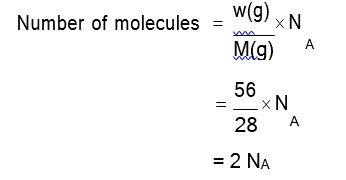
Molar mass of C7H5N3O6 = 12 × 7 + 1 × 5 + 14 × 3 + 16 × 6 = 84 + 42 + 96 = 227 g/mol
Number of moles = = 3 mol
-SO? H acts as a cation exchanger.
-NH? acts as an anion exchanger.
Taking an Exam? Selecting a College?
Get authentic answers from experts, students and alumni that you won't find anywhere else.
On Shiksha, get access to
Learn more about...

Chemistry Some Basic Concepts of Chemistry 2025
View Exam DetailsMost viewed information
SummaryDidn't find the answer you were looking for?
Search from Shiksha's 1 lakh+ Topics
Ask Current Students, Alumni & our Experts
Have a question related to your career & education?
See what others like you are asking & answering