
4.7 Given a + b + c + d = 0, which of the following statements are correct:
(a) a, b, c, and d must each be a null vector
(b) The magnitude of (a + c) equals the magnitude of (b + d)
(c) The magnitude of a can never be greater than the sum of the magnitudes of b, c, and d
(d) b + c must lie in the plane of a and d if a and d are not collinear, and in the line of a and d, if they are collinear?
4.7 Given a + b + c + d = 0, which of the following statements are correct:
(a) a, b, c, and d must each be a null vector
(b) The magnitude of (a + c) equals the magnitude of (b + d)
(c) The magnitude of a can never be greater than the sum of the magnitudes of b, c, and d
(d) b + c must lie in the plane of a and d if a and d are not collinear, and in the line of a and d, if they are collinear?
4.7
(a) This statement is In order to make a + b+ c + d = 0, it is not necessary to have all four given vectors to be null vectors.
(b) a + b + c +d = 0, ( a + c ) = - (b + d)
Taking the magnitude of both LHS and RHS, | a + c| = | -(b + d)| = | b + d|
So the statement is True.
(c) Given a + b + c + d =
 Upvote
Similar Questions for you

Please find the solution below:
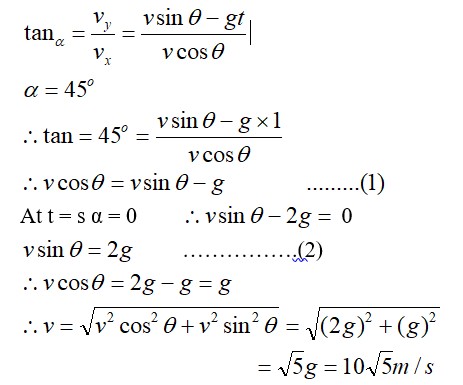
after 10 kicks,
v? = 3tî v? = 24cos 60°î + 24sin 60°? = 12î + 12√3?
v? = v? – v? = (12 – 3t)î + 12√3?
It is minimum when 12 - 3t = 0 ⇒ t = 4sec
ω = θ² + 2θ
α = (ωdω)/dθ = (θ² + 2θ) (2θ + 2)
At θ = 1rad.
ω = 3rad/s and α = 12rad/s²
a? = αR = 12 m/s² a? = ω²R = 9 m/s² A? = √ (a? ² + a? ²) = 15 m/s²
a? = v? ²/4r
a_A? = (v? ²/r²) × r = v? ²/r
a_A = 3v? ²/4r
Taking an Exam? Selecting a College?
Get authentic answers from experts, students and alumni that you won't find anywhere else.
On Shiksha, get access to
Learn more about...

physics ncert solutions class 11th 2023
View Exam DetailsMost viewed information
SummaryDidn't find the answer you were looking for?
Search from Shiksha's 1 lakh+ Topics
Ask Current Students, Alumni & our Experts
Have a question related to your career & education?
See what others like you are asking & answering