
A 10μF capacitor is fully charged to a potential difference of 50 V. After removing the source voltage, it is connected to an uncharged capacitor in parallel. Now the potential difference across them becomes 20 V. The capacitance of the second capacitor is:
A 10μF capacitor is fully charged to a potential difference of 50 V. After removing the source voltage, it is connected to an uncharged capacitor in parallel. Now the potential difference across them becomes 20 V. The capacitance of the second capacitor is:
Option 1 - <p>15μF</p>
Option 2 - <p>20μF<br><!-- [if !supportLineBreakNewLine]--><br><!--[endif]--></p>
Option 3 - <p>10μF<br><!-- [if !supportLineBreakNewLine]--><br><!--[endif]--></p>
Option 4 - <p>30μF</p>
10 Views|Posted a year ago
Asked by Shiksha User
1 Answer
A
Answered by
a year ago
Correct Option - 1
Detailed Solution:
By conservation of charge, (50) (10) = 20 (10+C) ⇒ C=15µF
 Upvote
Similar Questions for you

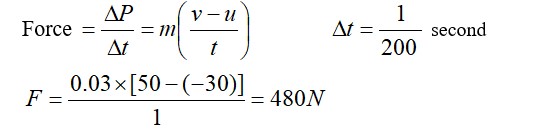

= 0.92 * 1260 = 1161 m/s
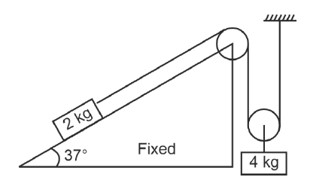
For 2 kg block
T – 2g sin37 = 2a . (i)
For 4 kg block
4g – 2T =
2g – T = a . (ii)
T = (2g – a)
2g – a – 2g × = 2a
3a = 2g ×
Taking an Exam? Selecting a College?
Get authentic answers from experts, students and alumni that you won't find anywhere else.
On Shiksha, get access to
67K
Colleges
|
1.2K
Exams
|
7.2L
Reviews
|
1.9M
Answers
Learn more about...

Didn't find the answer you were looking for?
Search from Shiksha's 1 lakh+ Topics
or
Ask Current Students, Alumni & our Experts
Have a question related to your career & education?
or
See what others like you are asking & answering