
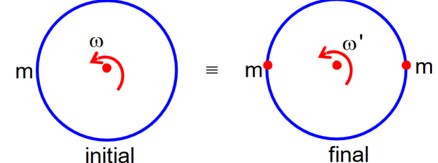
A thin circular ring of mass M and radius R is rotating with a constant angular velocity 2 rads-1 in a horizontal plane about an axis vertical to its plane and passing through the centre of the ring. If two objects each of mass m be attached gently to the opposite ends of a diameter of ring, the will then rotate with an angular velocity (in rads-1).
A thin circular ring of mass M and radius R is rotating with a constant angular velocity 2 rads-1 in a horizontal plane about an axis vertical to its plane and passing through the centre of the ring. If two objects each of mass m be attached gently to the opposite ends of a diameter of ring, the will then rotate with an angular velocity (in rads-1).
By conservation of Angular momentum
Li = Lf
 Upvote
Similar Questions for you
Angular impulse = Change in angular momentum
[J] = [mvr]
[J] = [M1L2T–1]
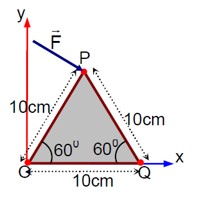
Position vector about O (r_o) = 5i + 5√3j
Force vector (F) = 4i - 3j
Torque about O (τ_o) = r_o × F
τ_o = (5i + 5√3j) × (4i - 3j)
τ_o = -15k - 20√3k = (-15 - 20√3)k
Position vector about Q (r_q) = -5i + 5√3j
Torque about Q (τ_q) = r_q × F
τ_q = (-5i + 5√3j) × (4i - 3j)
τ_q = 15k - 20√3k = (15 - 20√3)k
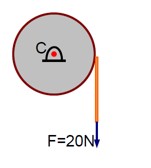
Kindly consider the following Image
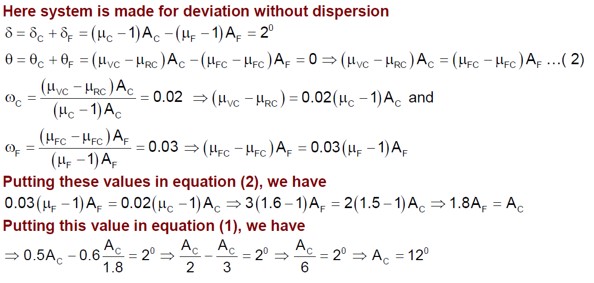
r? = 10αt²î + 5β (t-5)?
v? = dr? /dt = 20αtî + 5β?
As L? = m (r? × v? )
So, at t=0, L=0
given L is same at t=t as at t=0
⇒ r? × v? = 0
⇒ (10αt²î + 5β (t-5)? ) × (20αtî + 5β? ) = 0
⇒ 50αβt² (î×? ) + 100αβt (t-5) (? ×î) = 0
⇒ 50αβt² k? - 100αβt (t-5) k? = 0
⇒ 50t² - 100t (t-5) = 0
⇒ 50t² - 100t² + 500t = 0
⇒ -
The direction of torque and angular momentum defines how and in which orientation an object will rotate or sustain its spin. This is important to understand in machines, athletic movements, and even natural phenomena, such as planetary motion.
Taking an Exam? Selecting a College?
Get authentic answers from experts, students and alumni that you won't find anywhere else.
On Shiksha, get access to
Learn more about...

Physics System of Particles and Rotational Motion 2025
View Exam DetailsMost viewed information
SummaryDidn't find the answer you were looking for?
Search from Shiksha's 1 lakh+ Topics
Ask Current Students, Alumni & our Experts
Have a question related to your career & education?
See what others like you are asking & answering