
The net impedance of circuit (as shown in figure) will be:
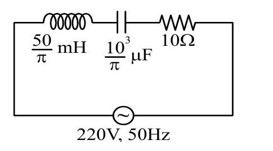
The net impedance of circuit (as shown in figure) will be:
Option 1 - <p><span class="mathml" contenteditable="false"> <math> <mn>25</mn> <mtext> </mtext> <mi mathvariant="normal">W</mi> </math> </span></p>
Option 2 - <p><span class="mathml" contenteditable="false"> <math> <mn>10</mn> <mroot> <mrow> <mrow> <mn>2</mn> </mrow> </mrow> <mrow></mrow> </mroot> <mi mathvariant="normal">Ω</mi> </math> </span></p>
Option 3 - <p><span class="mathml" contenteditable="false"> <math> <mn>15</mn> <mtext> </mtext> <mi mathvariant="normal">W</mi> </math> </span></p>
Option 4 - <p><span class="mathml" contenteditable="false"> <math> <mn>5</mn> <mroot> <mrow> <mrow> <mn>5</mn> </mrow> </mrow> <mrow></mrow> </mroot> <mi mathvariant="normal">Ω</mi> </math> </span></p>
25 Views|Posted a year ago
Asked by Shiksha User
1 Answer
 Upvote
Similar Questions for you
No power consumed without any resistance.
T = 2π√ (l/g) ⇒ g = 4π²l/T²
Percentage error: Δg/g = Δl/l + 2 (ΔT/T) = (0.1/10.0) + 2 (0.005/0.5) = 0.03
Percentage error = (Δg/g) × 100 = 3%
ω = 2πf = 100π rad/s
i_rms = i? /√2
While current changes from its maximum to its rms value, its phase changes by π/4 rad.
t = (π/4)/ω = π/ (4 × 100π) = 2.5 × 10? ³
XC = 1/ ωC
On increasing w; XC decreases so Z decreases, current in circuit increases.
Taking an Exam? Selecting a College?
Get authentic answers from experts, students and alumni that you won't find anywhere else.
On Shiksha, get access to
67K
Colleges
|
1.2K
Exams
|
7.2L
Reviews
|
1.9M
Answers
Learn more about...

Physics Alternating Current 2025
View Exam DetailsMost viewed information
SummaryDidn't find the answer you were looking for?
Search from Shiksha's 1 lakh+ Topics
or
Ask Current Students, Alumni & our Experts
Have a question related to your career & education?
or
See what others like you are asking & answering